Situations
The Temple of Bel
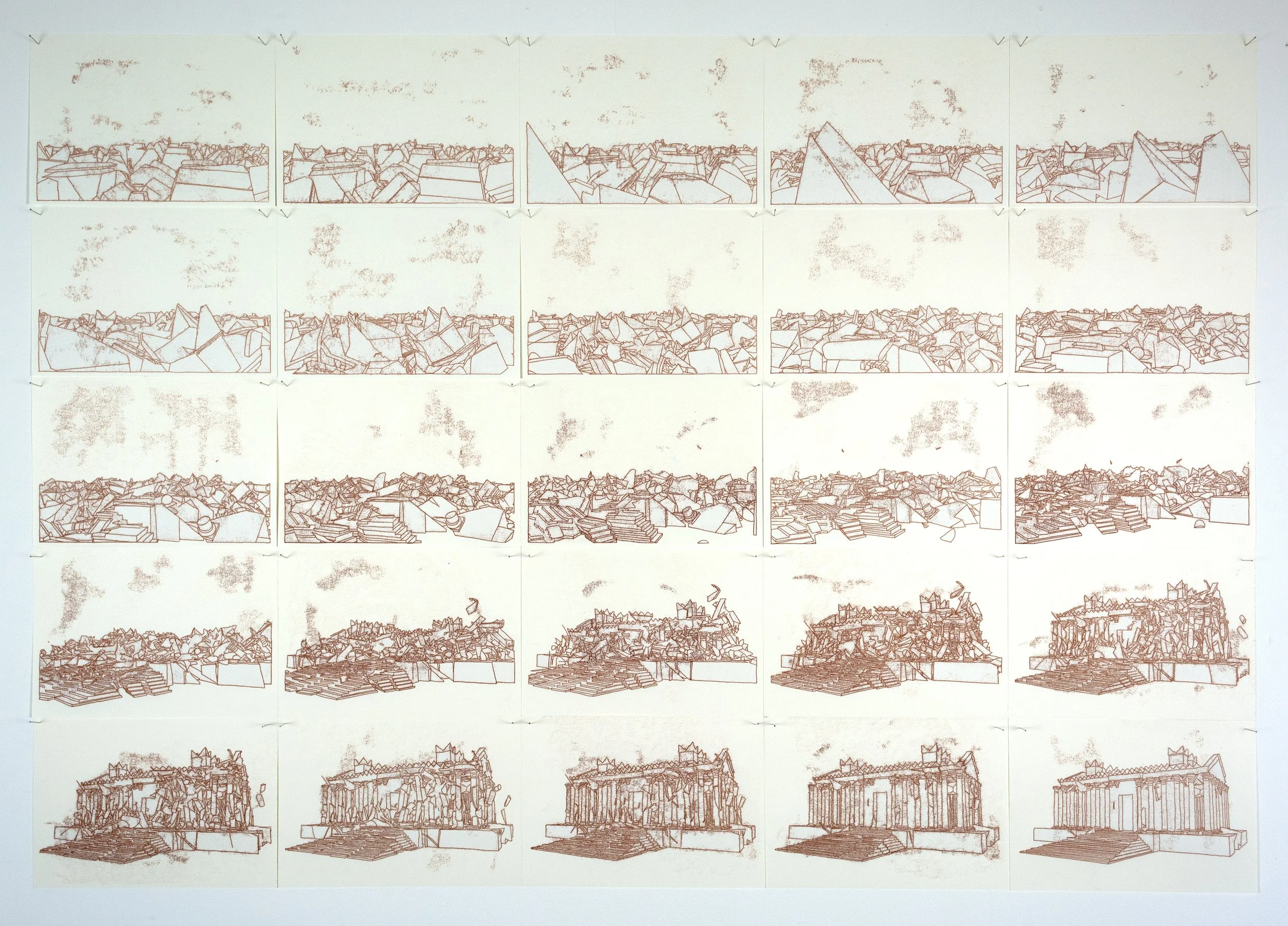
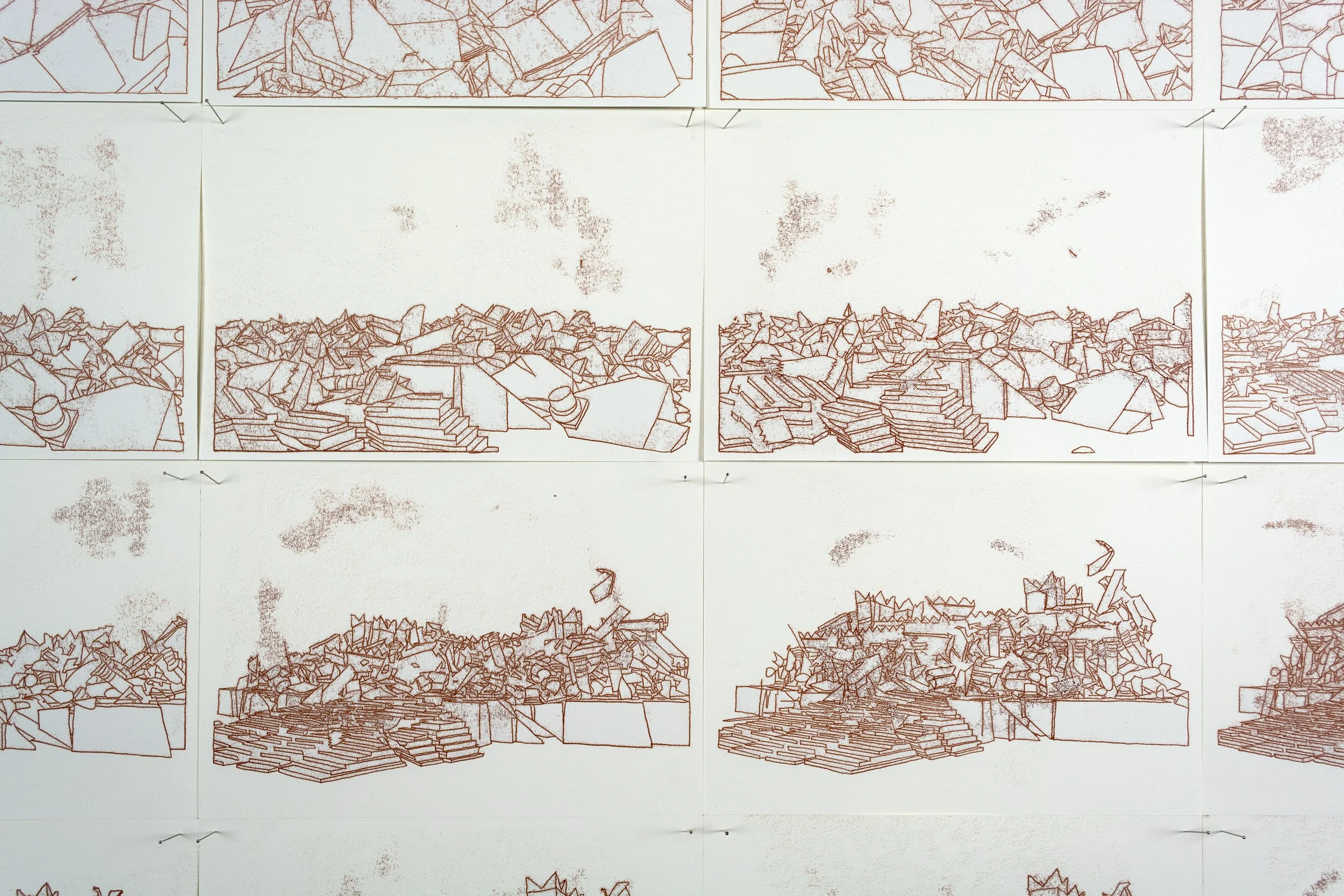
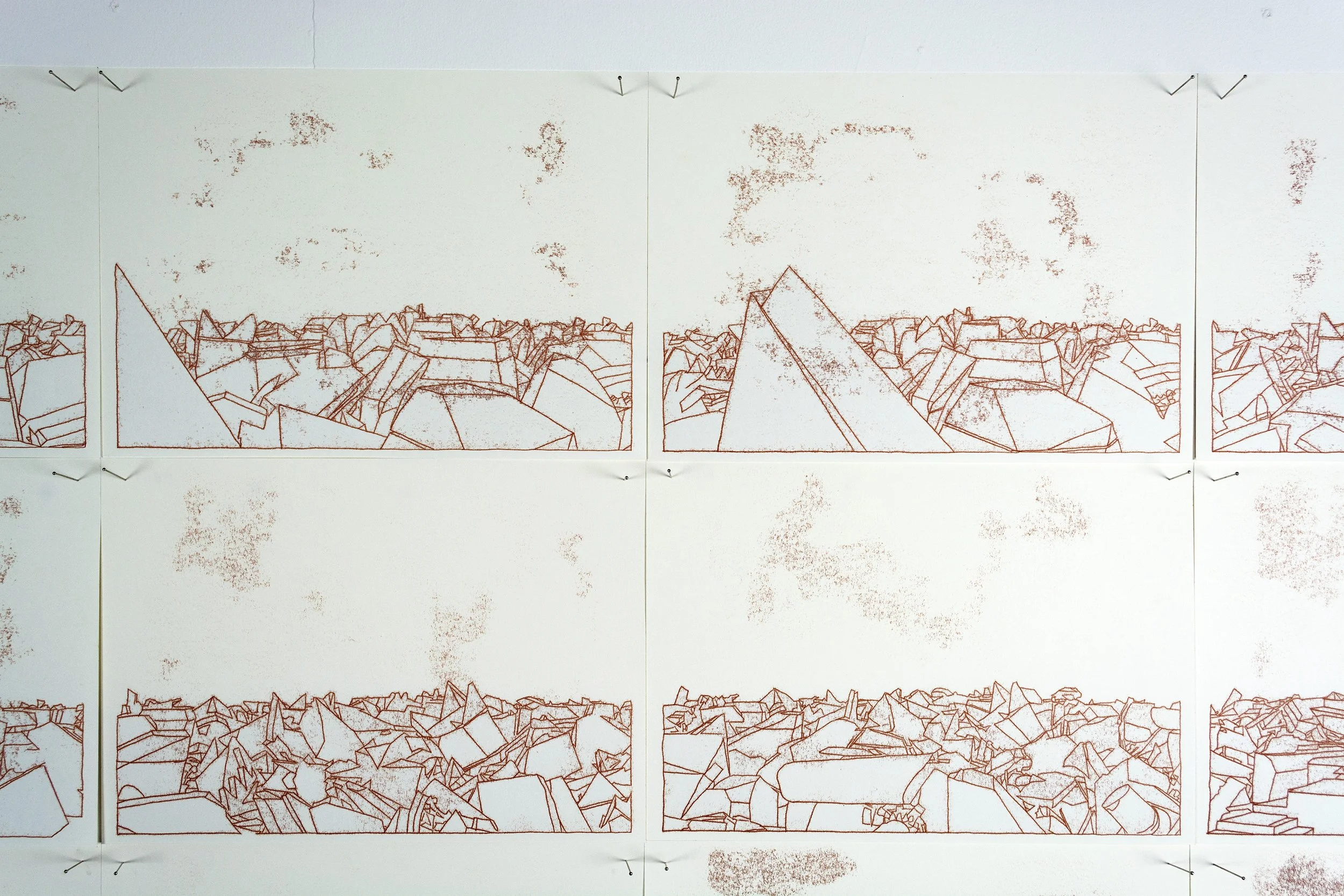
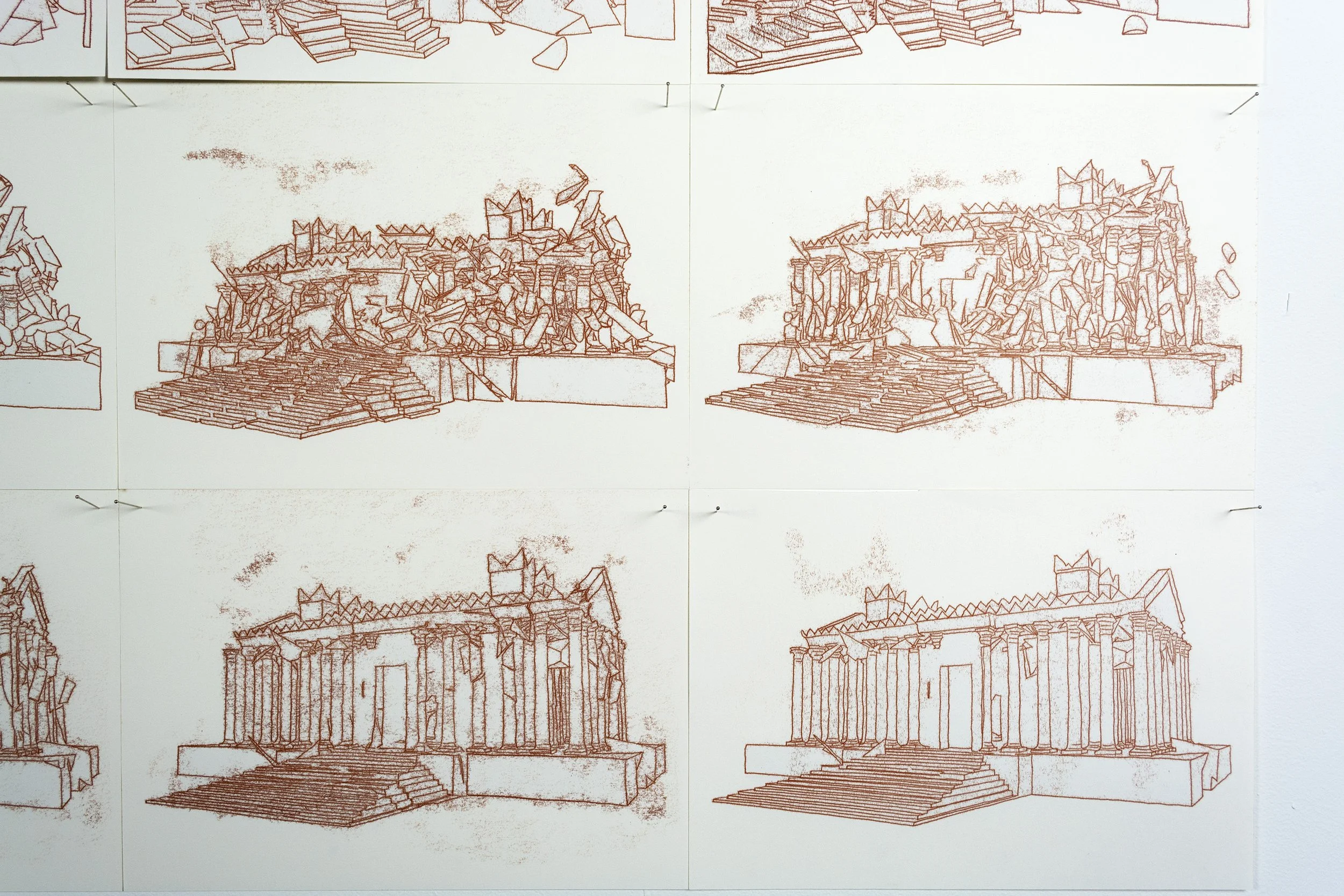
This drawing began as an immediate response to the 2015 destruction of the Temple of Bel in Palmyra, Syria, and was completed in 2026. Working from a photogrammetric 3D model pioneered by the University of Applied Sciences and Arts Switzerland, I simulated the temple’s collapse digitally and then back‑drew selected frames in ink. The process became a way of placing myself inside the moment of destruction, as a meditation on how we witness, remember, and locate ancient places within our own time.
Reversing the sequence and arranging the drawings as a field created a deliberate rupture, echoing archaeological grids and the deep human lineage of the site. Palmyra’s position between Mediterranean and Eastern worlds, a place shaped by intersecting cultures and shifting dominions, lends the work a historical charge.
The digital reconstruction, the simulated collapse, and the act of drawing form a cycle of understanding: not only of the building itself, but of its end point and its renewed presence. The work becomes a meditation on destruction, memory, and re‑materialisation.
The drawing lay dormant after its initial inception in 2016, archived away in a box. Its re‑emergence came only after time and distance allowed me to recognise it as a ritual, a flickering material history that I was finally ready to resolve and understand.

'Seraph', collagraph monoprint, H 72cm x W 63cm, 2023

[horizon grid] Mixed-media monoprint, 37cmx37cm, 2020
Collagraph relief prints
The drawings emerge as an aggregate of marks, responding to actions, where a structure pierces through a layer of matter, and another form appears. The drawings are a hybrid of materials and print, an assemblage that connects landscape with time. The linear and spatial, the physical and illusory seek to create spaces to hold our attention.

[Morphology]
Mixed-media monoprint, 37cmx37cm, 2019

[Event Horizon]
Mixed-media monoprint, 37cmx37cm, 2021


Untitled linear land study (freshly mowed lawn)
Archival inkjet print on Hahnemuhle paper, 93x39cm, 2012
The three-dimensional laser-scan is a way of making a rubbing, an archaeological impression extrapolated from the world and uncovered as a drawing artefact frozen in time.
Digital land drawings
The studio made digital scanner, a digital camera obscura, acts as a tool for recording and drawing site and landscape.
Untitled linear land study (tractor tyre patch)
Archival inkjet print on Hahnemuhle paper, 70x34cm, 2012
Untitled linear land study (tyre road middle)
Archival inkjet print on Hahnemuhle paper, 28x43cm, 2012
Shown as part of the linear land series of drawings. Shown at the Royal West of England Academy 'Drawn' show, 2013